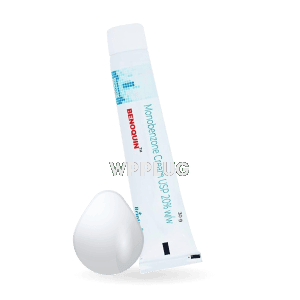
Benoquin Cream
| Product dosage: 20 gr | |||
|---|---|---|---|
| Package (num) | Per tube | Price | Buy |
| 1 | 85.41 $ | 85.41 $ (0%) | 🛒 Add to cart |
| 2 | 78.97 $ | 170.82 $ 157.95 $ (8%) | 🛒 Add to cart |
| 4 | 75.17 $ | 341.64 $ 300.69 $ (12%) | 🛒 Add to cart |
| 8 | 73.56 $
Best per tube | 683.28 $ 588.51 $ (14%) | 🛒 Add to cart |
Synonyms | |||
Benoquin Cream: Advanced Depigmentation for Vitiligo Management
Benoquin Cream is a prescription-strength topical treatment formulated with monobenzone, the only FDA-approved agent for permanent depigmentation. It is specifically indicated for extensive, treatment-resistant vitiligo, offering a final solution by permanently lightening remaining pigmented skin to achieve a uniform appearance. This cream represents a definitive therapeutic choice for patients who have exhausted repigmentation options and seek cosmetic uniformity. Its use requires careful medical supervision due to its potent and irreversible mechanism of action.
Features
- Active ingredient: Monobenzone 20%
- Pharmaceutical form: Topical cream
- Mechanism: Irreversible destruction of melanocytes
- Prescription status: Rx-only medication
- Packaging: Typically 30g tubes
Benefits
- Achieves permanent, uniform skin depigmentation in extensive vitiligo cases
- Provides definitive cosmetic solution when repigmentation therapies fail
- Reduces the noticeable contrast between pigmented and depigmented skin areas
- May improve quality of life by minimizing the appearance of vitiligo
- Single-agent formulation simplifies treatment regimen
- Topical application allows for targeted treatment
Common use
Benoquin Cream is exclusively indicated for permanent depigmentation of the skin in patients with extensive, treatment-resistant vitiligo affecting more than 50% of body surface area. It is not intended for partial vitiligo or other pigmentary disorders. The treatment is typically considered when other therapeutic modalities, including phototherapy and topical corticosteroids, have proven ineffective or unacceptable to the patient. Medical professionals reserve this option for cases where achieving uniform depigmentation is preferable to the patchy appearance of extensive vitiligo.
Dosage and direction
Apply a thin layer of Benoquin Cream to the remaining pigmented areas twice daily, approximately 12 hours apart. Gently rub into the skin until absorbed. Treatment should begin with a small test area to assess tolerance and response. Full treatment typically requires 6-12 months for complete depigmentation. Avoid application near eyes, mucous membranes, and uninvolved skin. Wash hands thoroughly after application. Sun protection is mandatory during treatment, as the skin becomes extremely photosensitive.
Precautions
Discontinue use immediately if hypersensitivity reactions occur. Regular monitoring by a dermatologist is essential throughout treatment. Patients should avoid sun exposure and use broad-spectrum sunscreen with SPF 30 or higher. The depigmentation is permanent and irreversible. Not for use in children under 12 years. Avoid contact with dark fabrics, as monobenzone may cause bleaching. Treatment should be conducted under close medical supervision with regular follow-up visits every 4-6 weeks.
Contraindications
Hypersensitivity to monobenzone or any component of the formulation. Not indicated for patients with limited vitiligo (affecting less than 50% of body surface area). Contraindicated in patients with history of melanoma or dysplastic nevi. Should not be used by patients with known sensitivity to hydroquinone derivatives. Pregnancy category C - not recommended during pregnancy unless potential benefits justify potential risks. Not for use while breastfeeding.
Possible side effects
Common: Localized skin irritation, erythema, pruritus, burning sensation, and dry skin. Expected: Progressive depigmentation of treated areas. Less common: Contact dermatitis, hypopigmentation of adjacent untreated areas (through transfer). Rare: Systemic effects including conjunctival melanosis and nail discoloration with prolonged use. Allergic reactions may occur in sensitive individuals. Paradoxical hyperpigmentation has been reported in some cases.
Drug interaction
No formal drug interaction studies have been conducted. However, theoretical interactions exist with other topical medications that may increase skin irritation. Concurrent use with other depigmenting agents is not recommended. Caution advised when using with topical corticosteroids or retinoids due to potential increased skin sensitivity. Systemic absorption is minimal but possible with large surface area application.
Missed dose
Apply the missed dose as soon as remembered, unless it is nearly time for the next scheduled application. Do not double the dose to make up for a missed application. Maintain regular twice-daily application schedule for consistent results. Irregular application may prolong the time to achieve complete depigmentation.
Overdose
Excessive application may lead to severe skin irritation, burning sensation, and increased systemic absorption. Symptoms may include nausea, dizziness, and abdominal discomfort. Treatment is supportive and symptomatic. In case of accidental ingestion, seek immediate medical attention. Gastric lavage and supportive measures may be indicated for oral overdose.
Storage
Store at controlled room temperature (20-25°C). Keep tube tightly closed when not in use. Protect from light and moisture. Do not freeze. Keep out of reach of children and pets. Discard any unused product 30 days after opening. Do not use if expiration date has passed.
Disclaimer
This information is for educational purposes only and does not replace professional medical advice. Benoquin Cream is a prescription medication that should only be used under the supervision of a qualified healthcare provider. Individual results may vary. The depigmentation effect is permanent and irreversible. Patients should thoroughly discuss benefits and risks with their dermatologist before initiating treatment.
Reviews
Clinical studies demonstrate that approximately 70-80% of patients achieve satisfactory depigmentation within 6-12 months of consistent use. Patient satisfaction surveys indicate improved quality of life scores in properly selected candidates. Dermatologists report that Benoquin remains the gold standard for permanent depigmentation therapy when appropriate patient selection criteria are followed. Long-term follow-up studies show maintained uniform appearance in successfully treated cases.