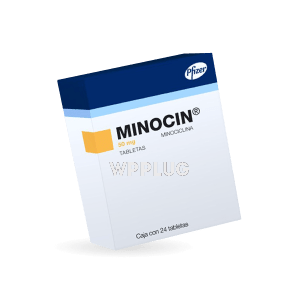
Minomycin
Minomycin Capsules are used for treating certain infections.
| Product dosage: 100mg | |||
|---|---|---|---|
| Package (num) | Per pill | Price | Buy |
| 30 | 2.96 $ | 88.92 $ (0%) | 🛒 Add to cart |
| 60 | 2.77 $ | 177.84 $ 166.14 $ (7%) | 🛒 Add to cart |
| 90 | 2.72 $ | 266.76 $ 244.53 $ (8%) | 🛒 Add to cart |
| 120 | 2.67 $ | 355.68 $ 320.58 $ (10%) | 🛒 Add to cart |
| 180 | 2.64 $
Best per pill | 533.52 $ 475.02 $ (11%) | 🛒 Add to cart |
| Product dosage: 50mg | |||
|---|---|---|---|
| Package (num) | Per pill | Price | Buy |
| 30 | 2.38 $ | 71.37 $ (0%) | 🛒 Add to cart |
| 60 | 2.18 $ | 142.74 $ 131.04 $ (8%) | 🛒 Add to cart |
| 90 | 2.11 $ | 214.11 $ 189.54 $ (11%) | 🛒 Add to cart |
| 120 | 2.08 $ | 285.48 $ 249.21 $ (13%) | 🛒 Add to cart |
| 180 | 2.03 $
Best per pill | 428.22 $ 366.21 $ (14%) | 🛒 Add to cart |
Synonyms | |||
Similar products
Minomycin: Potent Tetracycline Antibiotic for Systemic Infections
Minomycin is a specialized tetracycline-class antibiotic containing the active ingredient minocycline hydrochloride. It is formulated to combat a wide spectrum of bacterial infections, offering both broad-spectrum efficacy and favorable pharmacokinetic properties. As a semi-synthetic derivative, it demonstrates enhanced tissue penetration and absorption compared to earlier tetracyclines, making it a preferred choice in numerous clinical scenarios where deep-seated or intracellular pathogens are involved. Its lipophilic nature allows for effective crossing of biological barriers, including the blood-brain barrier, which is critical in treating certain serious infections.
Features
- Active ingredient: Minocycline hydrochloride
- Available in 50 mg and 100 mg capsules
- High oral bioavailability, not significantly affected by food
- Extended half-life allowing for twice-daily dosing
- Demonstrated efficacy against both gram-positive and gram-negative bacteria, as well as atypical pathogens
- Exhibits anti-inflammatory and immunomodulatory properties at sub-antimicrobial doses
Benefits
- Effectively treats moderate to severe bacterial infections, including respiratory, urinary tract, and skin infections
- Provides reliable coverage for acne vulgaris and rosacea due to its anti-inflammatory effects
- Suitable for use in neurosurgical prophylaxis and treatment of central nervous system infections owing to excellent cerebrospinal fluid penetration
- May be used as an alternative for patients with penicillin allergies in certain indications
- Demonstrates activity against some multidrug-resistant organisms, including community-acquired methicillin-resistant Staphylococcus aureus (CA-MRSA) in specific cases
- Offers convenient dosing regimen that supports patient compliance
Common use
Minomycin is commonly prescribed for bacterial pneumonia, bronchitis, sinusitis, and other respiratory tract infections caused by susceptible organisms. It is widely used in dermatology for inflammatory acne and rosacea management. Other frequent applications include treatment of urinary tract infections, sexually transmitted infections (particularly chlamydia), and tick-borne illnesses such as Lyme disease. In specialized settings, it serves as prophylactic treatment for meningococcal carriage and as adjunctive therapy in rheumatoid arthritis management.
Dosage and direction
The typical adult dosage ranges from 100 mg to 200 mg daily, administered in divided doses (usually 50-100 mg twice daily). For severe infections, an initial loading dose of 200 mg may be administered, followed by 100 mg every 12 hours. For acne treatment, doses typically start at 50-100 mg twice daily, often reduced to maintenance dosing after initial response. Administration should occur with a full glass of water to prevent esophageal irritation, and patients should remain upright for at least 30 minutes after ingestion. While absorption is not significantly impaired by food, dairy products, antacids, or iron preparations should be avoided within 2-3 hours of dosing due to chelation concerns.
Precautions
Patients should be advised that Minomycin may cause photosensitivity reactions, requiring use of sunscreen and protective clothing during treatment. Dental monitoring is recommended during extended therapy due to potential tooth discoloration in developing teeth and possible enamel hypoplasia. Regular liver function tests are advised during prolonged treatment courses. Use with caution in patients with hepatic impairment or those receiving other hepatotoxic medications. May cause dizziness or lightheadedness, particularly at initiation of therapy—patients should avoid driving or operating machinery until response is established. Not recommended during tooth development (last half of pregnancy through age 8 years) due to permanent tooth discoloration risk.
Contraindications
Minomycin is contraindicated in patients with known hypersensitivity to minocycline, other tetracyclines, or any component of the formulation. Contraindicated in children under 8 years of age (except for anthrax exposure management) due to effects on developing teeth and bones. Should not be used in patients with systemic lupus erythematosus or in those with significant hepatic impairment. Avoid use in pregnancy (category D) due to risk of fetal harm, including inhibition of bone growth and permanent tooth discoloration. Not recommended during breastfeeding due to secretion in breast milk and potential effects on infant bone and tooth development.
Possible side effect
Common adverse reactions include gastrointestinal disturbances (nausea, vomiting, diarrhea), dizziness, lightheadedness, and unsteadiness. Photosensitivity reactions ranging from exaggerated sunburn to severe dermatitis may occur. Less frequently, patients may experience pseudotumor cerebri (benign intracranial hypertension), manifested by headache and blurred vision. Tooth discoloration (yellow-gray-brown) may occur with prolonged use. Rare but serious effects include hepatotoxicity, autoimmune syndromes, and severe skin reactions such as Stevens-Johnson syndrome. Minocycline may rarely cause blue-black pigmentation of skin, nails, mucous membranes, and bones, particularly in areas of inflammation or previous injury.
Drug interaction
Minocycline may potentiate the effects of oral anticoagulants, requiring close monitoring of prothrombin time. Concurrent use with retinoids may increase risk of pseudotumor cerebri. Antacids containing aluminum, calcium, or magnesium, as well as iron preparations and bismuth subsalicylate, significantly reduce absorption through chelation. Barbiturates, carbamazepine, and phenytoin may decrease minocycline serum concentrations. May interfere with the bactericidal action of penicillins and should not be administered concurrently. Can reduce the efficacy of oral contraceptives—additional contraceptive methods are recommended during therapy.
Missed dose
If a dose is missed, it should be taken as soon as remembered unless it is nearly time for the next scheduled dose. In that case, skip the missed dose and resume the regular dosing schedule. Do not double the dose to make up for a missed administration. Maintaining consistent antibiotic blood levels is important for therapeutic efficacy, so patients should be advised to establish a routine dosing schedule. If multiple doses are missed, contact the prescribing healthcare provider for guidance.
Overdose
Overdose may manifest as dizziness, nausea, and vomiting. In severe cases, hepatic toxicity may occur. There is no specific antidote for minocycline overdose. Management should include supportive measures and symptomatic treatment. Gastric lavage may be considered if ingestion was recent. Not significantly dialyzable due to high protein binding—hemodialysis is not expected to enhance elimination. Monitor hepatic and renal function in significant overdose cases. Provide appropriate electrolyte replacement if vomiting is persistent.
Storage
Store at controlled room temperature (20-25°C or 68-77°F) in the original container. Protect from light and excessive moisture. Keep tightly closed and out of reach of children. Do not store in bathroom cabinets where humidity levels may fluctuate. Discard any unused medication after the completion of therapy or upon reaching the expiration date printed on the packaging. Do not flush medications down the toilet or pour into drains unless specifically instructed to do so.
Disclaimer
This information is provided for educational purposes only and does not constitute medical advice. Minomycin is a prescription medication that should be used only under the supervision of a qualified healthcare professional. The prescribing physician should be consulted for diagnosis and treatment decisions. Individual patient response may vary, and not all potential interactions or side effects are listed here. Patients should disclose their complete medical history and current medications to their healthcare provider before beginning treatment.
Reviews
Clinical studies demonstrate minocycline’s efficacy with success rates exceeding 85% in approved indications. Dermatologists frequently report excellent results in inflammatory acne management, with many patients showing significant improvement within 4-8 weeks. Infectious disease specialists value its tissue penetration properties, particularly in central nervous system infections. Some patients report gastrointestinal side effects initially, though these often diminish with continued use. The convenience of twice-daily dosing is frequently cited as a compliance advantage over more frequently dosed antibiotics. Long-term users should be monitored for potential pigmentation changes and periodic laboratory evaluations.